global event
Euroanaesthesia 2026: what the post-operative care conversation is actually about
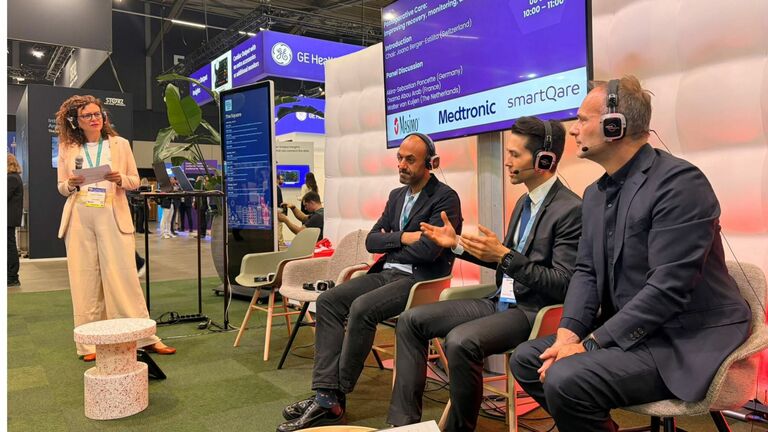
From 6-8 June, Euroanaesthesia (EA26), the annual congress of the European Society of Anaesthesiology and Intensive Care (ESAIC), brought together the European anaesthesiology community in Rotterdam, the Netherlands. Alongside the scientific programme, this year's Innovation Talks ran across three sessions: pre-operative, operative and post-operative care, tracing the patient journey through surgery.
smartQare, together with Masimo and Medtronic, sponsored the post-operative session, hosted by Prof. Joana Berger-Estilita. Our CEO, Walter van Kuijen, took part in the panel alongside Prof. Akira Poncette and Prof. Osama Bou Arab.
A few themes ran through that discussion that are worth pulling out.
Checking more often only helps if you're checking the right signs
Much of the conversation started from a simple observation: a patient on a general ward is typically checked three to four times a day. Continuous monitoring doesn't just add more data points, but it changes what "early deterioration" means, since a trend can be visible hours before an intermittent check would have picked it up.
That raises a practical question that came up repeatedly: not every vital sign needs to be continuous, and not every continuous data point needs to reach a clinician as an alert. Part of the discussion focused on defining which signals genuinely warrant continuous monitoring and which can stay intermittent because streaming everything, unfiltered, just trades one problem (missed deterioration) for another (alarm fatigue).
Monitoring doesn't stop at the hospital doors
A second theme was thinking about the surgical pathway as a continuum rather than a series of separate stages, with several speakers arguing that monitoring should start from the very beginning of a patient's digital pathway, not just once a concern appears. That continuity matters most around discharge: a few panellists pointed out that data gathered around surgery has value well beyond the operating room, and even beyond the hospital stay itself.
Training algorithms on that data could eventually help predict a patient's recovery trajectory after discharge, not just confirm what already happened. That reframes postoperative monitoring as something that extends toward home, rather than something that stops once a patient leaves the ward.
Scaling wireless monitoring is more a people’s problem than a technology problem
Staff training and clinical trust came up as the two main barriers to scaling wireless postoperative monitoring alongside a practical one raised from the floor: hospital IT departments are often stretched thin just maintaining existing systems, which becomes its own obstacle when a new technology is introduced. None of these are new arguments, but they were treated less as reasons to hold back and more as a checklist for what implementation actually requires.
Data ownership and governance were part of the same conversation. Cross-border data storage, GDPR compliance and clinicians' trust in the algorithms interpreting the data were all raised as prerequisites for scaling, not afterthoughts to solve once a system is already in use.
Alarm management tied back into this as well: several speakers pointed to nurse workload and alarm fatigue as the practical bottleneck, and to scoring systems like NEWS-style protocols needing adaptation for continuous rather than spot-check data.
From detecting deterioration to predicting it
Our CEO, Walter van Kuijen, made the point that this starts with quality clinical data: several initiatives, from companies and university clinics alike, are already working to derive predictive signals from that data, with published research suggesting deterioration can sometimes be predicted two to eight hours in advance. If that holds, earlier detection could turn what would have ended in an emergency room into a planned admission, a scheduled readmission, or a remote intervention instead. This could extend, step by step, into monitoring patients safely at home, at a fraction of the cost of a hospital admission.
That raises its own open questions: once monitoring extends into the home, which patients need attention first and what does a clinician need to know remotely to make a safe intervention decision? The panel didn't fully resolve either question, but both came up as the practical edge of where this is heading next.
The takeaway
Across every one of these themes, a consistent thread emerged: the technology to monitor patients continuously has already been proven to work. What's still catching up is implementation: staffing, alarm design, workflow fit and data governance keep coming up as the real bottleneck. For hospitals weighing whether to make the move, that distinction matters: the question isn't whether the technology can be trusted, it's how well the rollout is planned.
We will be publishing a longer piece on our own perspective on wireless ward monitoring and data ownership shortly. Follow our LinkedIn page to stay updated.
smartQare will attend Euroanaesthesia again in 2027.