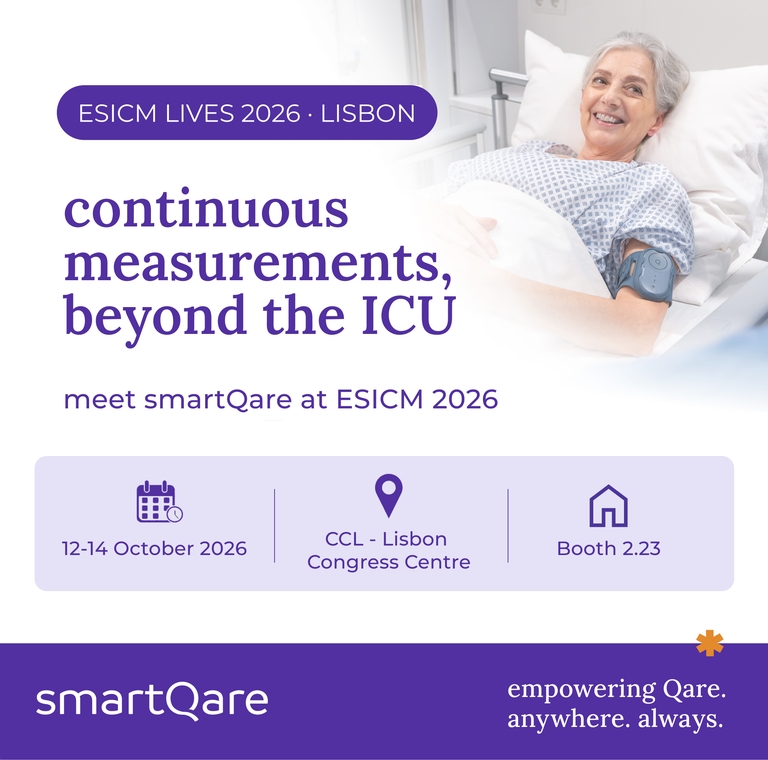
smartQare at ESICM LIVES 2026: continuous measurements, beyond the ICU
smartQare will be at ESICM LIVES 2026, the 39th Annual Congress of the European Society of Intensive Care Medicine, in Lisbon, Portugal, from 12 to 14 October 2026.
We are attending to demonstrate how continuous vital sign measurements can extend clinical visibility beyond the ICU, into the general ward and, where appropriate, into the home.
After ICU discharge
When a patient leaves the ICU, continuous monitoring usually gives way to intermittent checks. On most general wards, vital signs are recorded manually, often by nursing staff already managing a full patient load. Between those checks, there is limited visibility into how a patient's condition is changing. This is not a question of attention: a manual check can only show a patient's status at the moment it is taken.
For nurses, the challenge is having enough meaningful information to monitor patients without increasing the burden of manual checks. For patients, it is maintaining visibility of their condition as they move between care settings.
smartQare's approach is designed to provide continuous patient information while reducing reliance on manual spot checks and supporting monitoring across the care pathway.
What we are showcasing
viQtor is a wearable device for continuous vital sign monitoring on the general ward. It measures pulse rate, respiratory rate, oxygen saturation (SpO₂), activity and posture automatically. Data is sent directly over the mobile network, without separate hubs or gateways at the bedside, and is designed to integrate with existing hospital systems so it fits into current workflows.
smartQare's hospital-to-home solutions extend that same principle beyond the hospital, so care teams can keep following patients as they recover at home.
What makes continuous data usable
Measuring vital signs continuously is only useful if the data reaches clinicians in a form they can use. In practice, three conditions matter.
- Data quality. Continuous measurement gives clinical teams ongoing patient information and a more complete picture of how a patient's health status is changing over time.
- Connectivity. Data has to reach the care team without adding equipment at the bedside. viQtor has built-in mobile connectivity, so data is sent directly without separate hubs or gateways.
- Integration. Data needs to appear where clinicians already work. viQtor is designed to integrate with existing hospital systems, so continuous measurements fit into current workflows.
Together, these elements form the foundation of the smartQare ecosystem, connecting high-quality clinical data, built-in connectivity and integration with existing hospital systems across the patient care pathway: from ICU to ward to home.
Why this congress
This year's congress puts particular focus on precision in clinical care and practice-changing science.
Precision starts with the quality and continuity of the information available to healthcare teams. A single vital sign reading provides a snapshot at one moment; continuous data over time reveals how those values change, providing a more complete picture of a patient's condition.
Practice-changing science is about generating the evidence that helps new approaches move from innovation into everyday practice. viQtor is being used and evaluated in real clinical settings, building insight into how continuous measurement can best support earlier recognition of deterioration on the general ward, and help inform decisions about a patient's level of care.
Clinical evidence from Erasmus MC
Erasmus MC (Rotterdam, the Netherlands) will present a study at this year's congress on continuous vital sign monitoring with viQtor after ICU discharge.
The study, Continuous Vital Sign Monitoring After ICU Discharge: Real-World Ward Performance, Measurement Agreement, and Patient Acceptability of a Wearable Sensor, followed 180 patients for up to five days after ICU discharge. It looked at three questions that come before any clinical outcome: whether a wearable sensor produces usable data in routine ward care, the level of measurement agreement and whether patients are willing to wear it. The full results will be presented on 12 October.
Where to find us in ESICM 2026
- CCL - Lisbon Congress Centre, Booth 2.23
- 12–14 October 2026
At our booth, you can see smartQare's wearable devices first-hand, talk with our team about how continuous vital sign measurement could fit into your organisation and book a personal demo.
Erasmus MC presentation:
- 12 October, 16:46
- Poster Station H, Health Services Research & Outcome 6
Visit the smartQare booth to learn more about our wearable biosensor solutions and discuss how they could fit within your organisation. Schedule a time to meet with us during the event.